Examining Publishing, Graphic Arts, and Technology

Author: SEYBOLDREPORT (Page 3 of 6)

Digitization of Packaging: a Great Opportunity at drupa and Beyond

By Dr. Sean Smyth – Analyst & Consultant, Smithers

The drivers of sustainability, automation and workflow as the world continues to digitize dominate most print and packaging operations. Recruiting and retaining skilled staff is increasingly difficult for many businesses as baby boomers retire and the younger digital native generations demand a different approach to their working life.

Digital print developments will be center stage at drupa across all graphics, industrial and packaging and there will be further announcements this year. Digital packaging offers many opportunities for commercial printers looking to move into new sectors as many traditional print applications continue to decline. The same dynamic is encouraging more equipment suppliers to offer digital printing systems for labels, corrugated, cartons, flexible packaging, rigid plastics, glass and metal packaging.

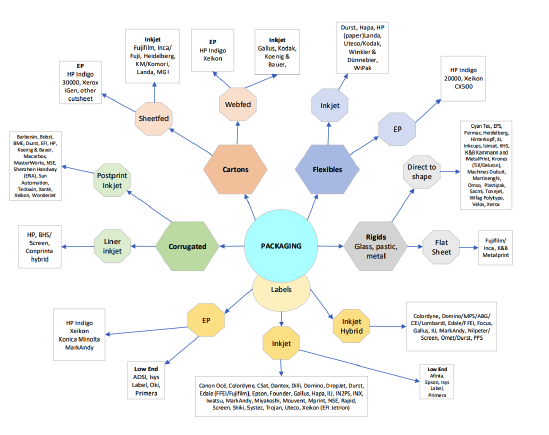
The figures below show how the suppliers of digital print equipment for labels and packaging have developed since this technology map was first produced in 2019. There has been a steady stream of new entrants, from established analog print equipment suppliers and new providers offering their digital print expertise. 

Digital printing systems for packaging and labels in 2019
Digital printing systems for packaging and labels in 2023
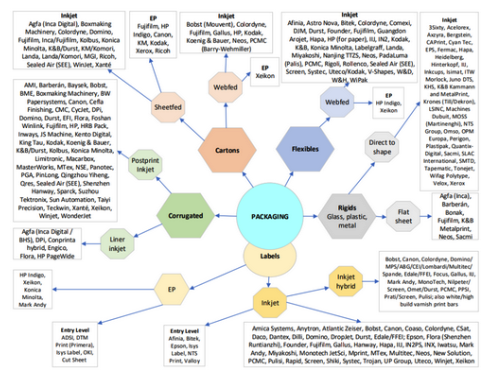
In addition to these there are digital overprint systems and sophisticated bespoke integrations, some operating as a part of manufacturing and filling lines. While there has been consolidation on the supply side, it is striking there have been few exits from the sector, the high number of players now competing in the wide range of packaging applications, offering new capabilities and functionalities, with steadily increasing productivity and lower costs.

Well, the good news for us print techies is this diagram (above) will get even more crowded this year. Smithers tracks the developments in this sector, publishing reports and running conferences on digitally printed packaging. The European, American, and Asian events bring together hundreds of brands, retailers, packer/fillers, converters, agencies and designers together with equipment, substrate and ink/toner suppliers, with workflow and logistics companies also involved.These are excellent forums and over the years the discussion moved from technology issues into tangible benefits and improved business processes from adopting digital printing, and increasingly digital finishing. Today quality, reliability and productivity are no longer issues for inkjet and electrophotography packaging presses.

At drupa there will be sheetfed inkjet machines offering the equivalent of process color sheetfed litho at speeds of 11,000 B1 sheets per hour and web presses offering speeds in excess of 400 mpm up to 2.8 m wide. These are mainstream alternatives to litho, flexo, and gravure alternatives.

The print head and press manufacturers are developing methods to eliminate inkjet artifacts, compensating for nozzle outs and deviations in real time that extend the life of the heads and machine uptime.

Inkjet will be the real winner, with faster machines being shown, particularly in flexible packaging. Ink technology is improving, with UV and water-based inks being employed for specific applications.

There will be more highly pigmented formulations helping reduce the ink film thickness while lowering the total cost of ownership further boosting the share of digital print.

It is not just printing. Some vendors will show single pass, highly automated systems to print and finish corrugated boxes, cartons and flexibles in a single pass. The enabler is the combination of digital print with digital finishing. These will feature automated control systems that drive the press, measure and check the print then track through finishing which may be coating, laminating, cutting, creasing, folding and gluing, together with a wide variety of embellishments.

The digital front end controllers are becoming increasingly powerful, automating and driving the digital print unit while at the same time measuring and controlling quality and then to set and drive the finishing technology. This approach helps replaces the traditional skills of press minders and finishing journeymen operators – important as skilled labor resources become scarcer.

While new digital presses are the shiny and sexy headline grabbers, even more important is the enabling workflow software. The only way of making money from a digital press is to produce saleable output and powerful workflow is vital to prepare the artwork files and keep the print queue well stocked. output and powerful workflow is vital to prepare the artwork files and keep the print queue well stocked.

This reality can be a barrier for packaging converters entering the sector as many do not have the necessary prepress and data handling skills. This year’s drupa will see many companies providing solutions with integrated management information systems to automate the administration needed to handle many short run jobs.

Workflow will become increasingly collaborative, with new designs produced and approved, then loaded into job queues for automated color management and imposition with no manual involvement at the converter. The MIS is linked, ordering substrates and planning the production on printer and finishing to meet the customer requirements and optimize capacity at the converter.

Digital workflow can be daunting for packaging converters accustomed to handling only a few large jobs but it is the way of the world. At drupa this year companies can explore solutions at drupa to simplify supply chains key to
future success supplying packaging and labels.

The market leaders offer a broad variety of creative software. They will show new methods to automate the repetitive processes involved with packaging design, approvals and prepress taking time and cost out of the process. Other players will offer specific solutions for integration and to optimize color management, imposition and providing variable data capability.

All these packaging developments are ultimately driven by end-customer expectations, or rather, demands. In the increasingly connected world these demands and expectations are changing, with more engagement and interaction to improve the consumer experience of the brand. Digital printing allows brands to make content decisions later in the supply chain. These additional functions move packaging beyond the traditional containment and protection functions, with information and promotion. A unique digital print product can be connected to the cyber world, opening new opportunities of logistical efficiency and greater consumer engagement.

This year’s drupa is an important print show because the exhibitors (and all the important ones will be there) will be showcasing what they have, while using the event to showcase what they are working on to gain feedback. And, digital packaging print (plus finishing) will very much be on the agenda.

There will be more machines for labels; corrugated – post and preprint, replacements for litholam; for folding cartons; for flexible packaging; for metal and there will be direct-to-shape machines doing interesting things on cans, aerosols, plastic and glass. Established players will show improvements to quality, speed and formats, with new inks and toners broadening the types of packaging they can produce.

In addition, I am really looking forward to seeing the newcomers who have already announced developments they will be showing off. I know of several potential developments sadly under NDA I am not allowed to mention until the show which is the bane of a technology correspondent. That will change when drupa opens. So, roll on May 2024!
Harvey Levenson on the His Road to drupa

I’ve been following with interest the various Internet postings regarding drupa 2024. The postings, called “The Road to drupa,” have been responses to articles appearing in various printing industry publications as well as in threads between individuals commenting on drupa 2024 and whether or not they will be attending.

Many of the postings are among tremendously respected colleagues and industry leaders that I’ve known for decades. A theme among quite a few is: “I won’t be attending drupa,” and some have expressed regrets and wishing they were attending. Unfortunately, I am one of them. Let me explain.

Anecdotal and Personal

First, I’ll be anecdotal and personal. For those who would like to, but will not be attending drupa, there is an alternative approach I experienced. The year was 2012 and I was prepared to attend drupa. Shortly before the event, my 94-year-old mother became ill (she passed away two years later at 96), and I had to remain close to home to assist with the situation. Hence, I canceled my trip.

However, I was determined to learn as much as possible about what was taking place at drupa. Luckily, the Internet was sufficiently matured at that time and coverage was provided from vendors and attendees, as well as in daily online publications about what was taking place. This information was important to me because I was still heading the Graphic Communication Department at Cal Poly, and it was imperative I be kept abreast of the latest developments in the field.

I disciplined myself to take an hour or two each day to just study what was being transmitted from Düsseldorf. At the end of the event, I asked myself: “What don’t I know now that I would have known had I attended drupa?” My answer to myself was, “nothing.”

Certainly, I missed the camaraderie, the socializing with my friends and colleagues who attended. But, as far as knowing the new technologies, applications, trends, and new industry thinking, I didn’t feel like I missed anything. I might have, but it sure didn’t feel that way. The point is I disciplined myself to spend some time each day on the Internet following what was occurring. I share this approach with those of you who will not attend the 2024 event but would have liked to.

Aging and Mobility

In reading the personal threads that have been written, I sense many are not attending, including myself, because our bodies are talking to us; telling us what we should and shouldn’t do as we age. I’m certainly experiencing that.

Occasionally, people ask me how old I am. My standard answer is, “From the knees down I am 81. However, from forehead up, I feel 18.” Hence, intellectually I feel no different than I ever did, and can absorb new information, new thoughts, and new approaches. However, my mobility and tolerance for long distance travel has changed.

I equate most business trips to being in a long tunnel, always indoor: vehicle to airport, airline (usually with several connections), airport, vehicle to hotel, hotel to site being visited (back and forth as many days needed), vehicle back to airport, airline, returning airport, vehicle back home. Short travel is fine, but long trips have become unsustainable with all of their air travel cancellations and delay uncertainties, and reduced services.

The Printing Industry Has Been Good to Me

Nevertheless, I appreciate and enjoy being able to keep up with the field that has been so important to me. I’m reminded of Sammy Sosa, that great baseball player from the Dominican Republic who said towards the end of his career, in his accent, “Baseball has been very good to me.” I like to say, in my Brooklyn accent, “Printing has been very good to me.”

I just can’t give it up and want to keep giving back. I flunked retirement. I’ve been in the field since 1961, including my education, and thought I was retiring in 2013. However, I was asked to stay on at Cal Poly for another year-and-a-half to help complete a special project. Additionally, my phone kept ringing, and I was led to understand I still had something to contribute to the industry: writing, research, speaking, serving is an expert witness, consulting, and so on.

Hence, I never really retired. Perhaps some of you are in the same situation. But, thanks to the power of the Internet many of us don’t have to retire because travel, which has become so tedious, is not as necessary as it used to be. Today, sitting home in the comfort of our own homes, dressed casually, and in control of our own time, we can do almost anything we used to enjoy doing when going to the office and when business travel was a more pleasant experience.

Thank You

So, I will again be attending drupa virtually, and I hope many of you will as well who would like to attend but cannot. I’ve already started my regimen of keeping up on the drupa 2024 news being posted daily on the Internet. I thank the industry press, the OEMs, and all others who made being on “The Road to drupa” possible.

Harvey
Harvey R. Levenson, Ph. D.

Professor Emeritus, Cal Poly

Five Years Ago in the Seybold Report: February 25, 2019

Five years ago in the Seybold Report we were sharing some big news about Xerox. Here are the first few paragraphs from the lead story in the issue.


On February 5, 2019 Xerox senior executives spent a few hours in the morning telling investors and, by extension, the world how the company plans to spend the next few years. The company also unveiled its latest corporate slogan: Made to Think. All of which made us think it was time to share the latest on Xerox with readers of this newsletter.

In this article we present highlights from the various presentations made that day along with a summary of how the company’s stock price has been doing, how various analysts have reacted to the company’s latest plans, how the legal fight with Fujifilm Holdings over the failed 2018 merger is going, and, of course, an Our Take.

The Investor Day presentation lasted about three hours and 17 minutes. Xerox recorded it and has made it available online as a Webinar. To access the recording, please visit https://webinars.on24.com/xerox/Investor2019.

The Latest Slogan: Made to Think
The press release for the Investor Day in February explains the origins of the new slogan thusly: “With a history of designing breakthrough technologies, Xerox is ‘made to think.’ We are taking a disciplined approach to creating the next generation of innovative technologies and intelligent
work solutions to meet our clients’ evolving needs,” says John Visentin, Xerox’s Vice Chairman and CEO.

“By simplifying our operations, instilling a culture of continuous improvement, investing in growth areas, and capitalizing on new and adjacent market opportunities, we anticipate we can achieve flat to growing revenue by 2021, while driving continued annual adjusted earnings per share expansion, including at least four dollars of adjusted earnings per share in 2020, and delivering over three billion of cumulative free cash flow over the next three years,” Visentin adds.

Five Years Ago in the Seybold Report: February 11, 2019

Five years ago this month in the Seybold Report newsletter we were discussing global print security, industry presence, and the continuing value of print. Below we have included a snippet from the lead article.

Quocirca Examines the Global Print Security Landscape


As we were going to press on this issue, Quocirca released news of its 
latest study on global print security. We found the theme of the report,
 Putting Print Security on the C-level Agenda, and the content of the report, very compelling. Print security is becoming a “greater concern,” as the report says, but, in the Joss Group’s opinion, graphic arts companies are not concerned enough about this matter, and there is much to be done to avoid crippling emergencies. Here we present a portion of the report along with Our Take and information on obtaining the full report.


Executive Summary


Data breaches are rarely out of the headlines and compliance pressure,
such as the introduction of GDPR, means security remains high on the
corporate agenda. Cyber threats and data breaches are no longer the
sole domain of the IT department, they must be considered at board level as the repercussions are simply too big to ignore.


Businesses of all sizes are potentially exposed to reputational, legal, and financial losses as the result of cyber attacks. Due to the increasing sophistication of attacks and the emergence of insider threats, businesses face a battleground to balance business productivity with the need for privacy and security. One area of the IT environment which is often overlooked is the print infrastructure. The majority of organizations rely on print to support business critical processes, meaning it can be the gateway to valuable, confidential, and sensitive information.


Quocirca’s Print Security 2019 report discusses how print security is becoming a greater concern to businesses with 59% reporting a print-related data loss in the past year. With only 27% classed as print security leaders, it is imperative businesses become more print security conscious, particularly as they look to close the paper to digital gap in their business processes. This [imperative] ultimately requires print security to move higher on the C-level agenda.

Reducing the Environmental Impact of Printing Inks

By Fabrice Peltier, Designer and Eco-design Consultant

drupa Essentials of Print Article No. 13, December 2023

The common factor in many graphic creations, especially in packaging design, is they are usually printed in large quantities to meet consumer demands. However, amid the focus on reducing packaging material consumption, one crucial aspect seems to have been overlooked: the environmental impact of printing inks. Often deemed insignificant, the inks used in graphic creations play a more substantial role than we might realize, both in terms of their ecological implications and economic considerations.

Understanding the composition of ink reveals its complex nature, which consists of several components. The pigments, or colorants, provide the vibrant hues that capture attention and differentiate brands. The vehicle, or binder, acts as the carrier, enabling the ink to adhere to various surfaces effectively. Additionally, adjuvants are used to enhance ink properties, ensuring quick drying times or improved resistance to wear and tear.

Each graphic element, typographic character, shape, and color thoughtfully chosen to convey the intended message represents a specific quantity of ink required for reproduction. Embracing an eco-friendly approach known as eco-inking (Ink Saving Process), designers can craft top-quality graphic designs while concurrently managing ink consumption during the printing process.

The eco-inking approach is best incorporated during the initial stages of design development, providing an intermediary step based on a well-conceived graphic proposal. However, forward-thinking designers may also consider eco-inking as an integral part of the entire design process, even at the conception of a brand’s graphic identity and guidelines.

The core objective of eco-inking is to optimize ink consumption without compromising the quality and visual impact of the creations. It seeks to achieve a harmonious balance between resource efficiency and creativity. Although changes made to ink usage might not be immediately apparent to consumers or readers, successful eco-inking initiatives have demonstrated their potential to bolster a brand’s environmental credibility and resonate positively with the intended target audience.

Moreover, adopting an eco-design philosophy in graphics goes beyond reducing ink consumption; it encompasses a holistic approach to environmental stewardship. By implementing eco-friendly practices in materials selection and production processes, designers can significantly reduce the environmental footprint of their work.

Notably, eco-inking also presents a compelling advantage when it comes to recycling. Graphic papers, extensively used for packaging and marketing materials, undergo a de-inking process during recycling to ensure the purity of the resulting paper. By minimizing the quantities of ink used in printing, eco-inked papers facilitate the de-inking process, reducing the consumption of chemicals and energy required to remove inks from the recycled material. This, in turn, minimizes waste production and contributes to a more sustainable circular economy.

For brand owners aiming to reduce costs, eco inking offers a potential source of savings. Using fewer inks directly impacts expenses, and opting for CMYK – or even CMY – printing can deliver outstanding results at even lower costs and with a reduced environmental impact.

The efficiency of the eco-inking approach has been proven by its practical application. Developed over a decade ago, this innovative technique has been meticulously tested on more than 250 consumer product packages in France. The results have been nothing short of remarkable, consistently achieving an average reduction of ink consumption by 20% to 25% while preserving the visual appeal and message impact of the original creations.

As a passionate advocate for sustainability and ecological responsibility in design, I firmly believe in sharing knowledge and expertise for the collective betterment of our environment. In this spirit, I have chosen to disseminate the eco-inking technique as an open source resource through comprehensive guides and training materials.

I encourage fellow designers, manufacturers, and businesses to embrace eco-inking and unlock the potential for positive change in our creative industries. Feel free to reach out and while you visit drupa, not only assume new substrates, new machinery and new technologies will help you to reduce the environmental impact of packaging – also consider new ways to conceive and produce packaging.

In conclusion, embracing eco-inking is not only a means to enhance the environmental sustainability of graphic creations but also an opportunity for designers to stand as pioneers of change in the ever-evolving landscape of design and consumer consciousness. Together, we can make a meaningful contribution to safeguarding our planet’s resources and ensuring a greener, more promising future for generations to come.

About the Author

Fabrice Peltier is recognized as an expert in packaging design, a pioneer in eco-design, working towards more environmentally responsible packaging solutions. He serves as a consultant and a catalyst for creativity in eco-design for the entire packaging industry, including packaging manufacturers, market players, and eco-organization

He regularly gives conferences and writes for multiple professional journals, including Emballages, a major French publication, where he has been conducting packaging analyses for more than 20 years. Additionally, he is the author of several books including La Révolution de l’emballage première et deuxième période and Pourquoi et comment entrer dans la Révolution.

Beyond his professional work, Fabrice Peltier is an elected local official in his village of Combloux, responsible for waste management, and a member of the SITOM office from Mont Blanc Valley – recycling company.

Peltier can be reached at www.fabrice-peltier.fr or on LinkedIn.

« Older posts Newer posts »

© 2026 The Seybold Report

Theme by Anders NorenUp ↑